
Article & News
Plantar Fasciitis Treatment: A Simple Home Plan
26/06/2026 · Khy Physio
If your first few steps in the morning feel like standing on a bruise or a drawing pin, you may be dealing with plantar fasciitis. The good news is that most people improve with a steady, sensible home program, and this guide walks you through a plantar fasciitis treatment plan you can start today.
What plantar fasciitis actually is
Plantar fasciitis is irritation of the thick band of tissue (the plantar fascia) that runs along the sole of your foot, from your heel to the base of your toes. It usually shows up as pain under the inside of the heel. The tell-tale sign is first-step pain: it hurts most with your first steps in the morning, or after you have been sitting for a while, then eases a little as you get moving before often returning later in the day.
It tends to build up gradually rather than from a single injury, often after a change in activity, more standing than usual, a rise in weight, or wearing flat, unsupportive shoes. This article is general information only and is not a diagnosis. Heel pain has several possible causes, so if you are unsure what is going on, it is worth having a physiotherapist or your GP take a look.
Step 1: Ease the morning first-step pain
That sharp pain when you first stand up happens because the fascia settles and stiffens overnight, then gets loaded suddenly when you take your weight. A gentle warm-up before your feet hit the floor makes a real difference.
- Before you get out of bed, point and flex your foot slowly 10 to 15 times, and draw the alphabet in the air with your big toe to wake the tissue up.
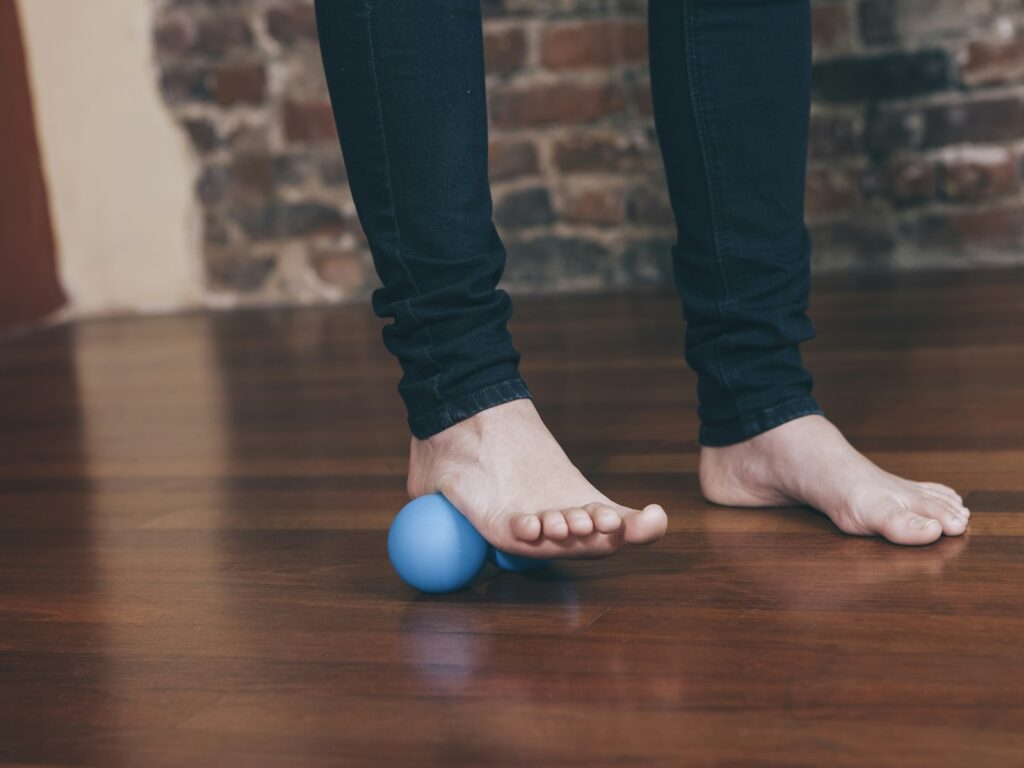
- Roll the sole of your foot for a minute or two on a firm ball (a tennis ball works, or a chilled water bottle from the fridge if it feels soothing). Sit down, keep the pressure comfortable, and roll from the heel towards the ball of the foot.
- Do a calf and fascia stretch (below) before you take your first proper steps, not after.
Keeping supportive shoes or firm slippers right beside the bed also helps, so you are not padding across hard floors barefoot first thing.
Step 2: Your daily stretching routine
Stretching the calf and the fascia is one of the most reliable parts of a plantar fasciitis treatment plan, because a tight calf pulls on the heel and adds to the load. Aim for a little and often rather than one big session. Stretches should feel like a comfortable pull, never a sharp pain.
Calf stretch against a wall
Stand facing a wall with your hands on it. Step the sore leg back, keep that heel down and the knee straight, and gently lean forward until you feel a stretch in your calf. Hold for about 30 seconds, then bend the back knee slightly to shift the stretch lower towards the heel. Repeat three times, two or three times a day.
Plantar fascia stretch
Sitting down, cross the sore foot over your other knee. Take hold of your toes and gently pull them back towards your shin until you feel a stretch along the arch. Hold for around 30 seconds and repeat three times, including before those first morning steps.
Step stretch (only if your balance is steady)
On a stair, let your heels drop gently below the step edge while holding the rail firmly with both hands. If your balance is not reliable, skip this one and stick with the wall and seated stretches. Holding on and staying safe always comes first.
Step 3: Manage the load, don’t just rest
Complete rest rarely fixes plantar fasciitis, and doing too much too soon flares it up. The aim is to keep the tissue working within a level it can tolerate, then build slowly. This is what we call load management.
- Reduce, don’t stop. Trim back the activities that spike your pain (long walks on hard ground, lots of standing) rather than sitting completely still.
- Break up standing. If you are on your feet for work or around the house, sit for a few minutes each hour, and stand on a softer surface such as a cushioned mat in the kitchen.
- Use the 24-hour rule. A little discomfort during activity is usually fine. If your heel is clearly worse the next morning, you did a bit too much, so ease back and rebuild more gradually.
- Add gentle strengthening once the sharp pain settles. Slow heel raises (rising up onto your toes and lowering down over a few seconds, holding a bench or rail) load the calf and fascia in a controlled way. Start with what feels easy and build up over weeks.
Progress with plantar fasciitis is usually measured in weeks and months, not days. Consistency beats intensity every time.
Step 4: Get your footwear right
What is on your feet matters as much as any exercise. The fascia does not get a chance to settle if it is loaded and pounded all day in flat, floppy shoes.
- Choose supportive shoes with a firm heel counter, a slightly raised heel and good arch support. A shoe you cannot easily fold in half is a good sign.
- Avoid going barefoot on hard floors at home, which is one of the most common reasons heel pain lingers. Wear supportive slippers or indoor shoes instead.
- Consider a soft heel cushion or an off-the-shelf arch support to take some pressure off the heel. Many people find these help, and a physiotherapist can advise whether custom orthotics are worth it for you.
- Replace worn-out shoes. If the sole is flattened or the support has collapsed, it is no longer doing its job.
When to get hands-on help
Plenty of people settle their heel pain with a steady home routine. But you do not have to battle on alone, and there are times when a proper assessment saves you weeks of guesswork. It is worth booking a physiotherapist if:
- Your pain has not improved after a few weeks of consistent stretching and load management.
- The pain is severe, stopping you sleeping, or getting worse rather than better.
- You are not sure it is plantar fasciitis, or the pain is in a different spot such as the back of the heel or across the whole foot.
- You have diabetes, poor circulation, or reduced sensation in your feet, where any foot problem deserves earlier professional input.
- Balance or mobility make the exercises hard to do safely on your own, or you have had a recent fall.
Because Khy Physio is a mobile service, we come to you, which is ideal if getting to a clinic on a sore foot is the last thing you feel like doing. A physiotherapist can confirm what is causing your pain, use hands-on techniques, tailor a strengthening program to your foot, check your footwear and progress you safely. You can book an in-home physiotherapy visit and we will bring the assessment to your lounge room. This kind of one-on-one support at home also suits older adults managing heel pain who would rather not travel.
Very occasionally, heel or foot pain needs urgent care rather than a routine appointment. See your GP promptly, or seek same-day medical help, if you notice heat, redness and swelling with a fever, sudden severe pain after a significant injury or fall, or new numbness and pins and needles spreading through the foot. If you feel unwell with these signs, or ever feel it is an emergency, call 000.
How your visit might be funded
Home-based physiotherapy for heel pain may be covered under several funding streams, so cost need not be a barrier. If you are an NDIS participant, physiotherapy can often be included in your plan through our NDIS physiotherapy support. Older adults may be able to use a Home Care Package or the newer Support at Home program to fund visits. Veterans may be eligible through DVA. If you are unsure what applies to you, our friendly team can talk you through the funding and pricing options.
Frequently asked questions
How long does plantar fasciitis take to get better?
For many people it settles over several weeks to a few months with consistent stretching, sensible load management and supportive footwear. It can take longer if it has been there a while. The key is doing a little every day rather than stopping and starting, and getting help early if progress stalls.
Should I rest completely or keep moving?
Complete rest usually is not the answer. Gentle, controlled activity within a comfortable level tends to help the tissue recover. The aim is to reduce the activities that flare your heel while keeping your foot moving, then slowly build back up. A physiotherapist can help you find the right balance for your situation.
Do I need orthotics or special insoles?
Many people do well with a supportive off-the-shelf insole or heel cushion, and you do not always need custom orthotics. What matters most is good overall footwear and not going barefoot on hard floors. A physiotherapist can assess whether a custom device is likely to add benefit for your feet.
When should I worry about heel pain?
See your GP or seek urgent care if you have sudden severe pain, signs of infection such as heat, redness and fever, numbness or pins and needles spreading through the foot, or pain following a significant injury or fall. For general, gradual first-step heel pain, a physiotherapy assessment is a sensible next step rather than an emergency.
Ready to sort out your heel pain?
You do not have to put up with painful first steps every morning. Start with the gentle stretches and footwear tips above, and if your heel is not improving, let us come to you. Book an in-home assessment or phone the Khy Physio team, and we will help you build a safe, personalised plan in the comfort of your own home, right across Melbourne and the Geelong region.

Written by
Calvin Yung, Mobile Physiotherapist
Calvin is a mobile physiotherapist at Khy Physio with a special interest in geriatric care, including mobility, balance, falls prevention and recovery after joint replacement. He speaks English, Cantonese and Mandarin. Meet Calvin