
Article & News
Knee pain going down stairs: causes, safer technique and exercises
06/10/2026 · Khy Physio
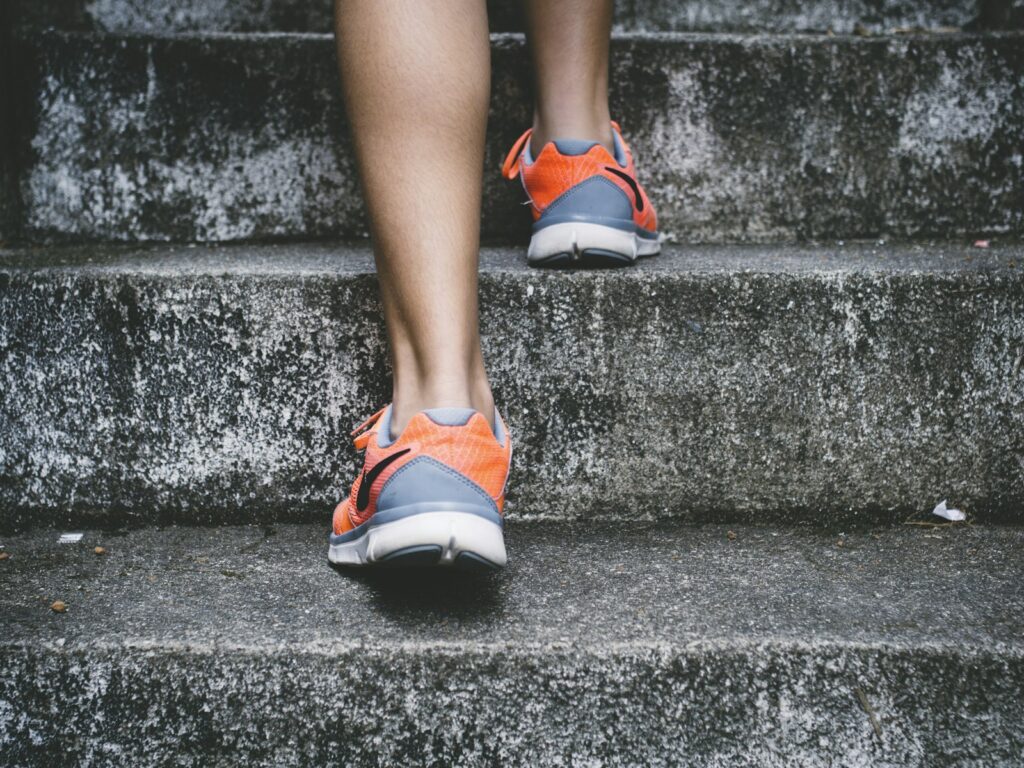
If your knee is fine on flat ground but aches the moment you head down the stairs, you are not imagining it. Knee pain going down stairs is very common, and there is a good reason stairs hurt more on the way down than on the way up. The good news is that a few changes to how you take the stairs, plus some simple strengthening, often make a real difference.
This guide explains the usual causes, a safer stair technique you can start using today, and home exercises that build the muscles your knee relies on. It is general information only, not medical advice. A physiotherapist or your GP can assess your knee and tell you what applies to you.
The short answer
- Going down stairs asks the muscles at the front of your thigh to control your whole body weight as the knee bends, which puts extra load through the joint behind the kneecap.
- Common causes include pain around the kneecap (patellofemoral pain), knee osteoarthritis, and weakness after an injury, surgery or a period of inactivity.
- Use the rail, take one step at a time, and remember: up with the good, down with the sore.
- Strengthening the thigh and hip muscles is a recommended first step for kneecap pain, and exercise is also central to managing knee osteoarthritis.
- See a doctor promptly if your knee locks, gives way, cannot take weight, or becomes hot, red and swollen.
Why stairs hurt more on the way down
Walking up stairs is mostly about pushing. Walking down is about controlling. Each time you lower yourself onto the step below, the big muscle at the front of your thigh (the quadriceps) has to work as a brake while the knee bends under your body weight. That braking action loads the joint where the kneecap glides over the thigh bone.
If that joint is irritated, or if the thigh and hip muscles are not strong enough to share the load, stairs down become the first thing to hurt.
Common causes of knee pain on stairs
Pain around the kneecap
Patellofemoral pain is pain around or behind the kneecap where it runs over the end of the thigh bone. Healthdirect notes it can be linked to how the kneecap tracks.
Knee osteoarthritis
Osteoarthritis is one of the most common reasons older adults find stairs harder. The joint may feel stiff first thing in the morning or after sitting, and stairs, kneeling and long walks can aggravate it. Our guide to knee osteoarthritis home exercises covers this in more detail.
Weakness after injury, surgery or illness
After a knee replacement, a fall, a hospital stay or even a few weeks of being less active, the thigh muscles lose strength quickly. Stairs are often the last task to feel normal again. If you are recovering from surgery, see our article on physiotherapy after knee replacement.
Other causes
Meniscus problems, tendon irritation and pain referred from the hip or back can also show up on stairs. That is why a proper assessment matters if the pain is not settling.
A safer way to take the stairs
While you work on strength, how you use the stairs can reduce pain and your risk of a fall. The same principle is taught in Victorian hospital guidance for people using crutches, and it works well for a sore knee too: lead with the stronger leg going up, and with the sore leg going down (Safer Care Victoria).
Going up
- Hold the handrail firmly. If there are two rails, use both.
- Step up with your good leg first.
- Bring the sore leg up to the same step.
- Pause, then repeat. One step at a time is fine.
Going down
- Hold the handrail and stand close to the edge of the step.
- Lower your sore leg to the step below first.
- Bring your good leg down to join it.
- Pause and repeat, taking your time.
Why it works: going up, the good leg does the lifting. Going down, the good leg does the braking while it stays on the higher step, so the sore knee has much less work to do.
A few other tips help. Wear supportive, non-slip shoes rather than socks or loose slippers. Keep stairs well lit and clear of clutter. If you use a walking stick, ask your physio to show you how to manage it on your particular stairs. Our falls prevention guide has more home safety ideas.
Home exercises for stronger knees on stairs
For pain around the kneecap, an international consensus of researchers recommends exercise therapy, with combined hip and knee exercises preferred, as a first-line approach (Crossley et al, British Journal of Sports Medicine, 2016). The exercises below are a gentle place to start.
Safety first: hold a stable surface such as a kitchen bench whenever you are standing. Mild, familiar discomfort that settles soon afterwards is usually acceptable, but stop if pain is sharp, if the knee swells, or if you feel unsteady. Start with a small number of repetitions, such as 5, and build up slowly over the weeks. A physio can set the right amount for you.
1. Sit to stand
- Sit towards the front of a firm chair with arms, feet flat and hip-width apart.
- Lean forward slightly, press through both feet and stand up. Use your hands on the armrests if you need to.
- Slowly lower yourself back down, taking about 3 seconds to sit.
The slow lowering trains the same braking action you need on stairs.
2. Small step-ups
- Stand facing the bottom step, holding the rail.
- Step up with one leg, straighten it, then bring the other foot up.
- Step back down slowly, leading with the sore leg.
Start with the lowest step you have. If this hurts, go back to sit to stand for a while.
3. Mini squats at the bench
- Stand holding the bench with both hands, feet hip-width apart.
- Bend your knees a small amount, as if starting to sit, keeping your weight through your heels.
- Straighten up again. Only go as low as is comfortable.
4. Side leg lifts
- Stand side-on to the bench, holding it with one hand.
- Keeping your body upright and toes facing forward, lift the outside leg a short way out to the side.
- Lower it slowly. Swap sides.
This strengthens the hip muscles that help keep the knee in line as you step down.
5. Calf raises
- Stand holding the bench with both hands.
- Rise up onto your toes, then lower slowly.
When to see your doctor
Most stair-related knee pain can be managed with the right exercise and technique, but some signs need a medical review. Healthdirect advises seeing your doctor if you cannot move your knee, cannot put any weight on it, if it locks or gives way, or if it is very painful.
Go to an emergency department if:
- your knee is badly swollen or has changed shape
- you have a fever along with a red, hot knee
- the pain follows a major injury or fall
Also get prompt medical advice if you have new calf pain or swelling, especially after surgery or a long period of sitting.
How a home physio can help
Stairs are a very personal problem: your steps have their own height, rail and lighting. With home visits, your physiotherapist can watch you on the stairs you actually use, check your technique and set exercises that match your home. They can also assess the cause of your pain, look at your hips and feet, and adjust your program as you get stronger. Learn more about our musculoskeletal mobile physiotherapy.
Frequently asked questions
Should I avoid stairs if my knee hurts?
Usually not completely. Using a safer technique and building strength is generally better than avoiding stairs altogether, which can lead to further weakness. If stairs are unsafe for you right now, a physio can help you plan how to manage them in the meantime.
Is knee pain on stairs a sign of arthritis?
It can be, but it is not the only cause. Pain around the kneecap and muscle weakness are also common. An assessment can help work out what is going on.
Will a knee brace help with stairs?
A brace or tape is not a substitute for strengthening, which has the strongest support. If you are curious about a brace, ask your physio whether it is worth trying in your situation.
How long before exercises make stairs easier?
It varies. Muscles take several weeks to get stronger, so steady practice matters more than doing a lot at once.
Get help with knee pain at home
If stairs are becoming a struggle, our physiotherapists can come to you across Melbourne and the Geelong region to assess your knee and build a plan around your home. Make a referral or contact our team on 03 8824 0712 to book a home visit.

Written by
Calvin Yung, Mobile Physiotherapist
Calvin is a mobile physiotherapist at Khy Physio with a special interest in geriatric care, including mobility, balance, falls prevention and recovery after joint replacement. He speaks English, Cantonese and Mandarin. Meet Calvin