Parkinson’s Disease and Physiotherapy: How Movement Helps
Living with Parkinson’s disease brings daily physical challenges – from stiffness and tremors to balance problems and difficulty walking. Physiotherapy for Parkinson’s disease plays a vital role in managing these symptoms, slowing functional decline, and helping people stay mobile and independent for longer.
At Khy Physio, our mobile physiotherapists travel directly to your home across Melbourne, making it easier to access the consistent, ongoing care that Parkinson’s management requires.

What Is Parkinson’s Disease?
Parkinson’s disease is a progressive neurological condition that affects movement. It occurs when dopamine-producing cells in the brain gradually break down, disrupting the brain’s ability to coordinate smooth, controlled movement.
Common symptoms include:
- Tremors, particularly in the hands
- Muscle stiffness and rigidity
- Slowness of movement (bradykinesia)
- Balance and coordination problems
- Shuffling gait and freezing episodes
- Stooped posture
- Difficulty with fine motor tasks
Symptoms vary between individuals and typically worsen over time, though the rate of progression differs greatly from person to person.
How Physiotherapy Helps People with Parkinson’s Disease
Physiotherapy cannot reverse Parkinson’s disease, but it is one of the most effective tools for managing its physical symptoms. Regular physiotherapy helps maintain strength, flexibility, balance, and functional capacity – all of which decline without targeted exercise.
Research consistently shows that people with Parkinson’s who engage in regular physical therapy experience slower functional decline, fewer falls, and a better quality of life.
Improving Balance and Reducing Falls Risk
Falls are one of the most serious concerns for people living with Parkinson’s. Balance problems, freezing episodes, and postural instability all significantly increase fall risk.
Physiotherapy addresses this through:
- Balance retraining exercises
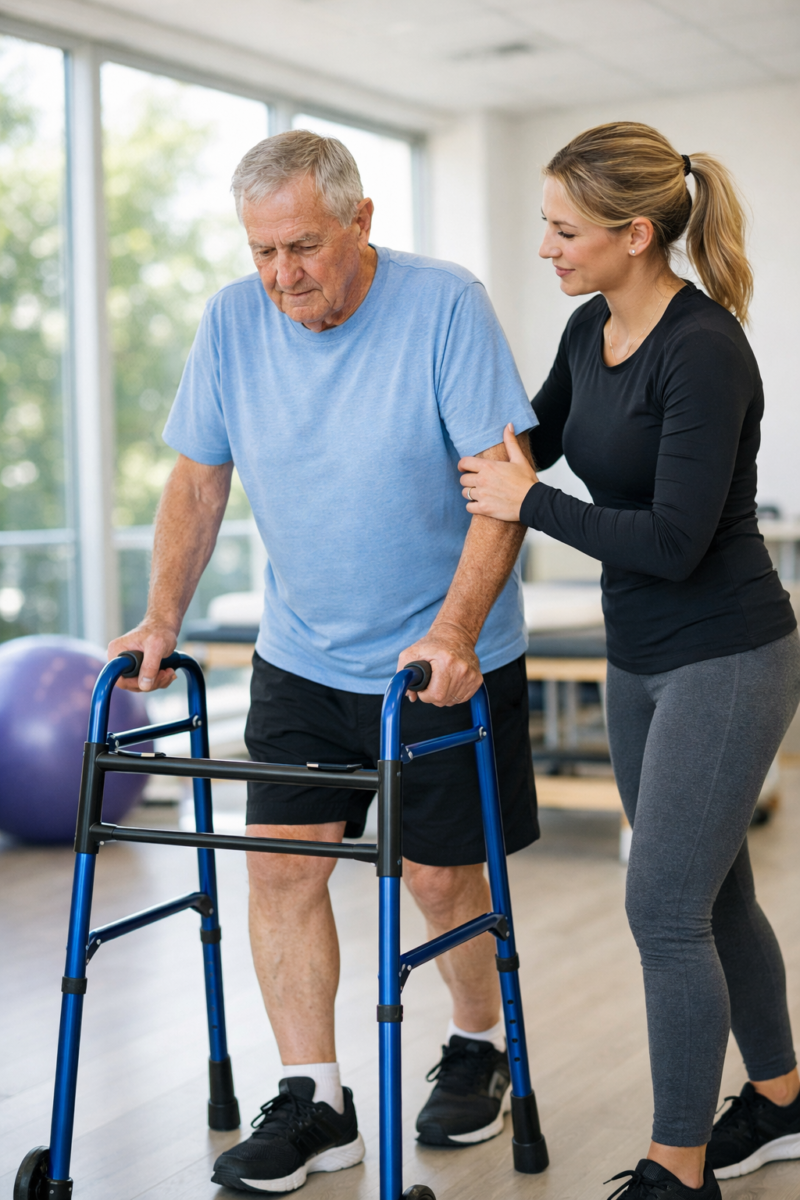
- Gait training to address shuffling and freezing
- Cueing strategies – visual, auditory, or rhythmic prompts that help initiate movement
- Strength training targeting the core, hips, and legs
- Home environment assessment to identify and reduce trip hazards
Maintaining Mobility and Strength
Muscle rigidity and inactivity lead to rapid deconditioning in Parkinson’s. Physiotherapy focuses on maintaining range of motion through stretching and mobility work, and building the strength needed for everyday tasks like rising from a chair, climbing stairs, and moving safely around the home.
Posture and Breathing
Parkinson’s commonly causes a forward-stooped posture that affects breathing, swallowing, and balance. Physiotherapists work on postural correction and breathing exercises to reduce these secondary complications over time.
Exercise Prescription
Exercise is considered one of the most important non-medication treatments for Parkinson’s disease. Your physiotherapist will design a personalised exercise program tailored to your current stage of Parkinson’s, physical capacity, and goals – and update it as your needs change.
Why In-Home Physiotherapy Works Well for Parkinson’s
Getting to a clinic regularly can be difficult when you’re managing tremors, fatigue, or mobility challenges. Mobile physiotherapy removes that barrier entirely.
At Khy Physio, we bring physiotherapy directly to your home across Melbourne, so you receive consistent care in a familiar, safe environment. We can also assess your home for fall risks and tailor exercises to the spaces where you actually live and move – something a clinic visit simply cannot offer.
For people with Parkinson’s, consistency and routine are key to maintaining function over time. In-home care makes that consistency far more achievable.
Funding Options for Parkinson’s Physiotherapy
Many people living with Parkinson’s disease can access physiotherapy through funding programs rather than paying out of pocket.
NDIS: Khy Physio is a registered NDIS provider. If your NDIS plan includes Improved Daily Living supports, physiotherapy may be covered.
Support at Home Program: For older Australians receiving aged care support, physiotherapy can often be included as part of your care plan.
DVA: Eligible veterans can access gap-free mobile physiotherapy through the Department of Veterans’ Affairs.
Private: We also support private clients across Melbourne. to discuss your options.
Contact us to discuss which location suits you and to arrange your initial assessment.
Khy Physio provides mobile physiotherapy across Melbourne for older Australians accessing services through My Aged Care, Home Care Packages, and the Support at Home program. If you’d like to find out how we can help, contact our team or call 0410 803 034. We respond within 24 hours.